Commercial Roof Moisture Surveys: Why They're Flown at Night
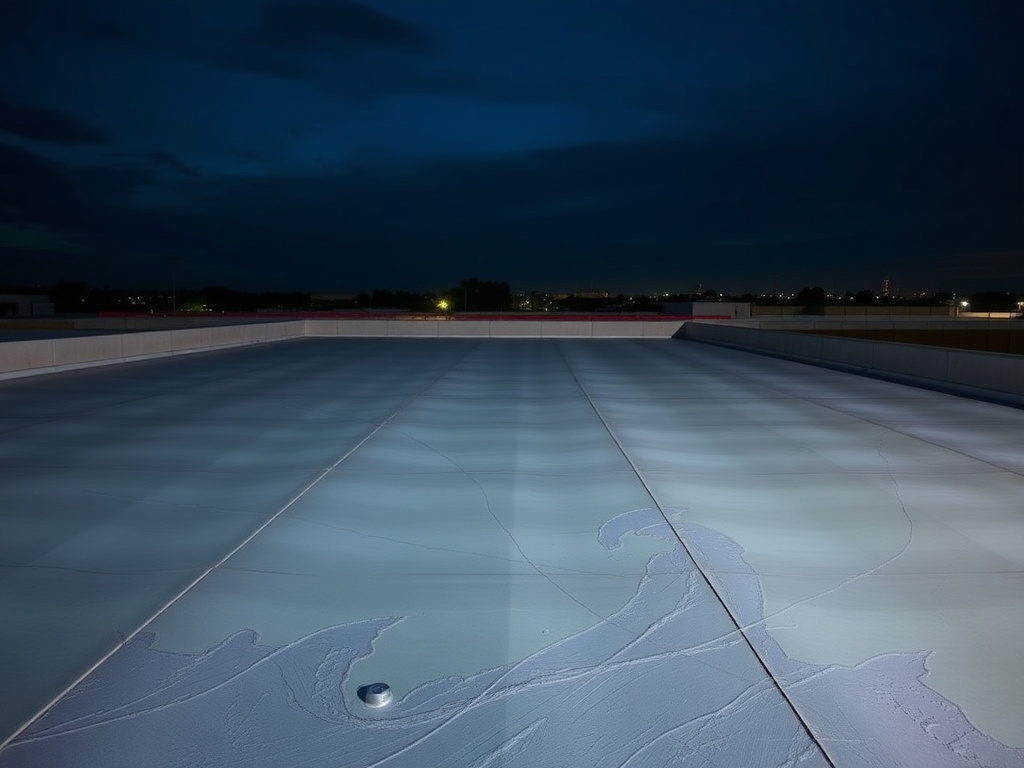
Flat and low-slope commercial roofs — EPDM, TPO, built-up, and modified bitumen systems — share a specific vulnerability: once water gets under the membrane, it can spread and saturate the insulation layer below without ever producing a visible sign on the roof surface itself. By the time a stain shows up on a ceiling tile inside the building, the moisture has often been there for months.
A different thermal principle than an insulation scan
This is worth understanding up front, because it's a genuinely different mechanism than a residential insulation scan. Wet material has higher thermal mass than dry material — it takes longer to heat up, and it takes longer to cool down. During the day, the sun heats the entire roof surface fairly evenly. After sunset, that's where the two diverge: dry sections of roof release their stored heat quickly, while wet or saturated sections hold onto it longer.
A few hours after sunset — after the roof has started cooling but before the whole surface equalizes to ambient temperature — the wet areas read measurably warmer than the dry areas around them. That's the window a moisture survey is flown in.
Why the temperature difference is smaller than people expect
Unlike an insulation gap, which can produce a fairly large, obvious temperature contrast, a roof moisture signature is often subtle — commonly just a few degrees between wet and dry areas. That's exactly why the equipment and the interpreter matter more than they might for a more dramatic thermal anomaly: a high-sensitivity radiometric camera and a trained eye are what separate a genuine moisture read from noise.
Why drones outperform a walked survey here
A technician walking a roof at night with a handheld thermal unit faces real limitations: oblique viewing angles that distort readings, missed sections on large or multi-level roofs, and the practical hazard of walking an unfamiliar membrane surface in the dark. A drone flies a consistent top-down pass across the entire roof, producing a stitched, distortion-free moisture map — and it does it without a single footstep on the membrane, which matters on roofs where foot traffic itself is a liability.
What a moisture survey delivers
- A full-roof thermal map with suspected moisture zones outlined and ranked by apparent severity
- Radiometric temperature data behind each flagged zone, not just a color-coded image
- Matching visual-light imagery for every flagged area
- GPS-tagged, timestamped captures suitable for maintenance records, capital planning, or your own claims documentation
What happens after you get the report
A thermal survey is a screening and documentation tool — it tells a roofing contractor precisely where to focus physical core samples or moisture-meter checks, rather than testing the entire roof blind. Flagged zones typically become the starting point for a targeted repair scope instead of a full section replacement, which is where most of the cost savings of catching moisture early actually come from.
Frequently asked questions
It varies by roof system and how saturated the material is, but differentials are often modest — commonly just a few degrees. That's why survey conditions and camera sensitivity matter so much for an accurate read.
Low-slope roofs are the primary use case since that's where membrane systems and trapped moisture are most common, but the same nighttime thermal principle can apply to any roof assembly where moisture retention under a covering material is a concern.
Ready to request an inspection?
Tell us about your property and we'll scope the right thermal inspection.