Residential Insulation Inspection
Thermal drone imaging that maps your entire roofline and attic from the outside — pinpointing missing, thin, compressed, or improperly installed insulation without cutting into a single wall.
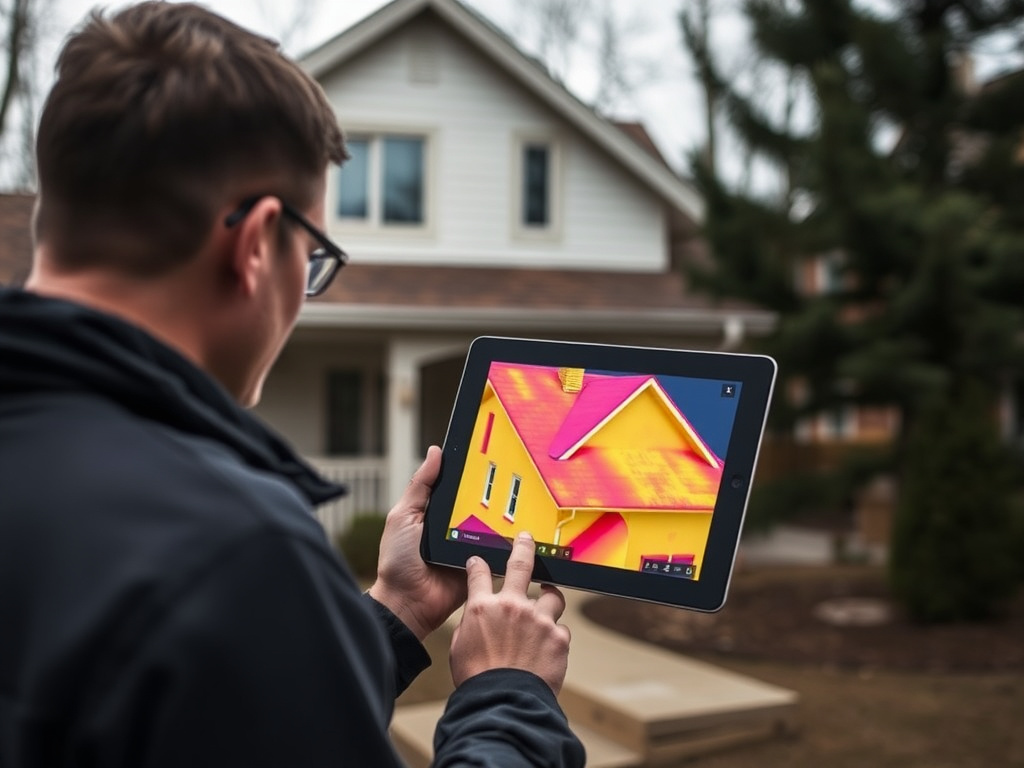
Insulation's job is to slow heat transfer. Where it's missing, too thin, compressed, or was installed with gaps, heat moves through that section of the ceiling or wall far faster than it does through the properly insulated areas around it. A thermal (infrared) camera doesn't see through the roof deck or drywall — it reads surface temperature — but that temperature difference is exactly what shows up as a distinct color-contrast patch on a thermal image, often outlining stud bays, attic-hatch edges, or the gaps around wiring and duct penetrations that fiberglass batts get installed around instead of sealed against.
A meaningful temperature difference between inside and outside is what makes those patches show up clearly, which is why we schedule scans for early morning or evening — whenever your home's specific conditions give us the clearest read. A drone lets us capture the entire roofline and attic from a consistent top-down and oblique angle in a single flight, instead of the room-by-room, wall-by-wall process a handheld thermal camera requires from inside the house — and it avoids a problem that trips up handheld inspections: an inspector's own body heat skewing close-range readings.
You get a report that pairs each flagged area with its matching thermal and visual-light image, so you're not just told "there's a problem in the northeast corner" — you can see it.
Why it's requested
- No demolition or drywall cuts required to see where insulation is missing or thin
- Full attic and roofline coverage captured in a single flight, not just the areas you can physically access
- Flags settled, compressed, or improperly installed insulation that's invisible to a visual walkthrough
- A documented, dated report you can hand to any insulation contractor for an accurate, apples-to-apples quote
How a thermal scan actually finds missing insulation
Every surface emits infrared radiation based on its temperature, and a radiometric thermal camera converts that radiation into a color-mapped image — warmer areas in one range of the palette, cooler areas in another. Where insulation is doing its job, the ceiling or wall surface reads close to a consistent, expected temperature. Where it's missing, thin, or compressed, that section of surface tracks much closer to the outdoor temperature than it should — showing up as a distinct patch against the surrounding, properly insulated background.
That contrast is what our pilots are trained to interpret: distinguishing a genuine insulation gap from other thermal anomalies like a duct leak, a recessed light fixture, or simple sun exposure on one side of the roof. It's the reason a raw thermal image on its own isn't a report — the interpretation is the actual deliverable.
What you'll see in your report
Every flagged area is documented with a matching pair of images — the radiometric thermal capture and a standard visual-light photo of the same spot — plus a plain-language note on the likely cause and its approximate location on the roofline or attic plan.
- Side-by-side thermal + visual imagery for every flagged area
- GPS-tagged, timestamped captures for a defensible, dated record
- Plain-language notes on likely cause (gap, compression, missing coverage, etc.)
- A summary you can hand directly to an insulation contractor for a quote
Best conditions for an accurate scan
Thermal contrast depends on a meaningful temperature difference between the inside of your home and the outside air — without it, the whole envelope reads close to the same temperature and gaps don't stand out. That's typically easiest to achieve in the early morning or evening, or during seasons with a real day/night or indoor/outdoor swing. Wind, rain, and direct, uneven sun exposure on the roof can all distort a reading, so we schedule around conditions rather than a fixed calendar slot.
Ideal for
- Homeowners with unexplained hot or cold rooms, or a summer cooling bill that doesn't add up
- Buyers doing pre-purchase due diligence before closing on a home
- Property managers auditing insulation coverage across a rental portfolio
- Anyone collecting insulation contractor bids who wants an independent, unbiased map of the actual problem areas first
What affects the cost
Insulation Inspection questions, answered
Yes — that's the core of what infrared thermography is built for. It reads surface temperature differences caused by heat moving faster through gaps, thin spots, or compressed insulation, and those differences show up as clear, mappable patches on the thermal image. It won't tell you the exact R-value of what's there, but it will show you precisely where the problem areas are.
Whenever gives us the clearest read for your specific home — usually early morning or evening, when there's a meaningful temperature difference between the inside of the house and the outside air. We'll confirm the best window when we schedule your flight.
No — a thermal drone insulation scan is a focused, specialized documentation tool, not a substitute for a licensed general home inspector. It's commonly used alongside a standard inspection to add insulation- and envelope-specific detail a general inspection doesn't capture.
Not necessarily — most residential insulation scans are flown entirely from outside the property. We'll confirm access requirements when scheduling.
Related services
Ready to request a insulation inspection?
Tell us about your property and we'll dispatch an FAA Part 107 certified pilot to map insulation gaps, roof moisture, or heat loss — with a clear report in your hands within days.